Extruded Aquatic Food Using
Food Industry by-products
Saleem Taqvi
Extrusion-cooking is recognised as a basic technology in food and feed manufacture. Different food industries byproducts such as fish meal, groundnut cake, soybean cake, deoiled rice bran, soybean seed, fish oil with wheat flour and a binder were extruded in a single screw extruder to produce a semi-intensive aquatic food. The product quality was influenced by correct formulations of the products, proper processing conditions such as the particle size of the raw materials, moisture contents, feed rate, extrusion pressure, temperature and geometric design of the barrel, the screws and system locks. After a lot of trial the best result obtained by using a formulation containing 31% fish meal, 15% groundnut cake, 30 soybean cake, 11% soybean seed, 6% wheat flour, 5% deoiled rice bran, 1.75% fish oil and 0.25% guargum. The pulverized mixed raw materials size was minus 40 mesh and having 9% moisture content. The extrusion pressure and temperature were 35 bar (Kg/sq.cm) and 114 C respectively at the feed rate of 18Kg/minute. After extrusion 33% moisture containing product was followed by drying in a packed bed dryer at a temperature of 65-70 C for 2 hours and size reduced to 5-6 mm by a six blade cutter at 600 r.p.m. The yield was 78% and stable in water for more than 7 hours. The product F.C.R. gave a satisfactory result (1.45:1).
The food extruder is considered as a high-temperature short-time bio-reactor that transforms a variety of raw ingredients into modified intermediate and finished products (Harper, 1989). The advantage of extrusion are evident, especially in the simplification of processing techniques for the manufacture of existing products as well as in the development of new or novel types of food (Meuser, Wiedmann, 1989). Previously the technology was used in the manufacture of RTE cereals and snacks. In our country it is technology has not been fully exploited in the production of aquatic food with proper utilisation of some food industries byproducts namely fish meal, soybean cake, groundnut cake, deoiled rice bran, fish oil etc. with some starchy materials. These products are cooked and formed on a single screw extruder at about 25% moisture. It is therefore necessary to dry down a moisture of 9-12% (wet basis) (Cosgriff et al, 1985).
The product quality is influenced by extruder design, recognizable in physio-technological aspects such as residence time, shear type and level, degree of mixing, temperature development and thorough put (Van Zuilichem, 1985).
The present investigations were undertaken to develop a correct formulation based on food industries byproducts and to study the process parameters in the extrusion process. It will help a proper utilisation of food industries byproducts in a systemetic way.
Materials and methods:
All raw materials (Fish meal, ground nut cake, soybean cake, soybean seed, deoiled rice bran, wheat flour, guargum, fish oil) were procured from local market and analysed the proximate composition in the laboratory by AOAC methods. The initial laboratory analysis helped to achieve a correct formulation of the product. The used formulation in this study was shown in Table 1. All the ingredients except wheat flour, fish oil and guargum were pulverized in an industrial pulverized (Capacity 1 ton/hr, Hardcase Engg, Hyderabad) and passed through a sieve of 40 mesh (recycle 5%) to a horizontal continuous mixer. The wheat flour, guargum and fish oil were added directly to the mixer. The calculated volume of water was added to the mixer and mixed well for 30 minutes to get a desired level of uniform moisture content (20%). The powdery materials were sent to extruder bin before extrusion then next to feeder.
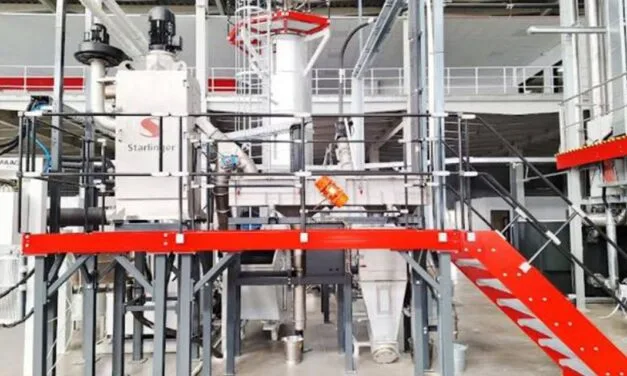
Extrusion was performed on a single screw extruder (INOTEX-100, France). One circular die was fitted in the die plate having 0.5mm clearance. The feed rate was 18 kg/minute. The moisture content and barrel temperature profile used in this study are shown in Table 2. An adjustable die face cutter with six blades was operated at 600 rpm to cut the extrudate at the pellet size of 5-6 mm. Steady-state extrusion conditions were assumed to have been reached when no visible drifts were observed in product temperature at the die and all the process parameters at steady state are shown in Table 3.
The highly moist pelleted products were dried in a packed bed dryer for 2 hours at the temperature of 70-80% C and packed in HDPE bags for storage at room temperature. The proximate composition of the product is shown in Table 4.
Results and discussion
Table 1 shows the correct formulation for the manufacturing of prawn feed. This formulation gives a water stable product (solubility more than 7 hours). MPEDA, however suggested more than 6 hours. We had tried to replace wheat bran instead of rice bran and gelatin in place of guargum but did not get better results. The water stability was only for 3 hours. The water stability also depends on protein content and when it reduces below 30% then stability decreases. Low fat content increases craving. 0.25% guargum is the optimum binder to manufacture prawn feed. The water stability increases with the increase of binder and decreases with the reduction of binder addition. Guargum is the cheapest binder among others.
Barrel temperatures and the moisture level at different stages are shown in Table 2(a) and (b). The temperature increased systemetically from inlet section to compression section and finally to treatment section. The compression section in the middle, is where the products heated and transferred in a sort of viscous paste. In the treatment section the major energy is transferred into heat driving from friction and shearing action of the products. This is where the product to extrude rapidly heats up to temperature of around 114øC.
The moisture level also increased step by step. The mixed pulverized raw materials (having moisture content 9%) at the time of extrusion. The mixing time moisture level 20% changed to 33%. The excess amount of water was injected downstream from the centre of the feed part to the extruder and adjusted to give a moisture content of 33% in the feed.
Table 3 depicts the optimum process conditions for extrusion. The optimum pressure and temperature observed in the process were 35 bars and 114øC. The feed rate was 18 kg/min and this was the maximum at available power supply. Due to high pressure inside the extruder, the water or moisture inside the product does not boil, it stays liquid at high temperature and under important pressure. Within these conditions the reaction occur very rapidly.
The six blades cutter at 600 rpm cut the extruded sausage at the size of 5-6 mm coming out of the extruder when the extruded product comes out of the extruder under an elastic rope form having 0.5 mm diameter. The product dried at 70-80øC and there was no shrinkage in the product.
The proximate composition of the finished product is shown in Table 4. The observed datas were lying below MPEDA specifications. The water stability of the product was more than 7 hours. The feed conversion ratio (F.C.R.) also gave a satisfactory result on a trial basis at Sunderban region of West Bengal.
___________________________
Author is faculty member at Department of Food Science and Technology, Guru Nanak Dev University, Amritsar